Summermist
Bengal Cats was founded by Sheila and John Fowler as a natural progression from
their phenomenally successful Summermist Standard Poodles.
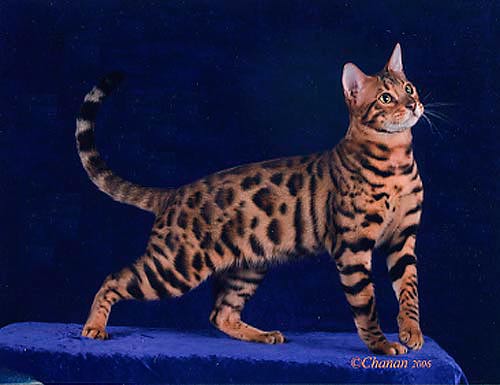
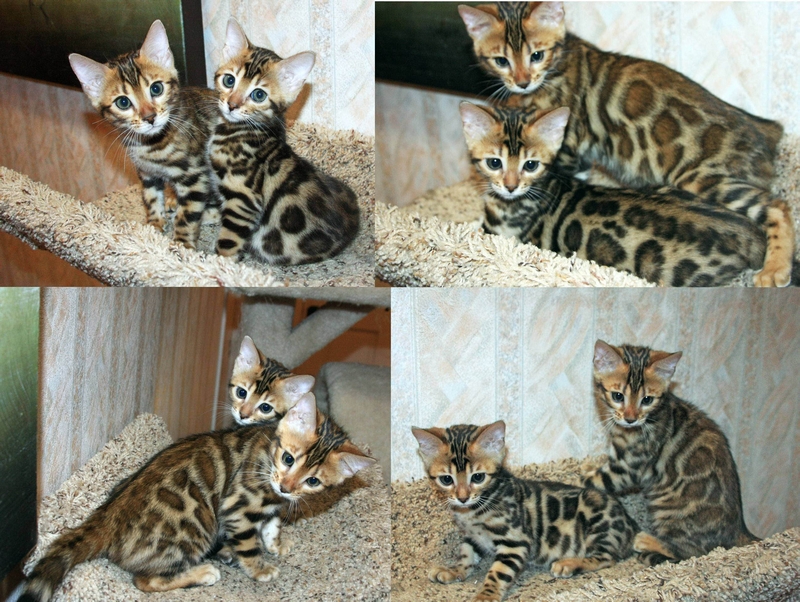
We have beautiful Rosetted Bengal Cats and Rosetted Bengal Kittens for sale.
The Story of
Our Bengal Kitten, Purrrcy
Written by
John & Sheila Fowler
Summermist
Bengal Kittens and Bengal Cats
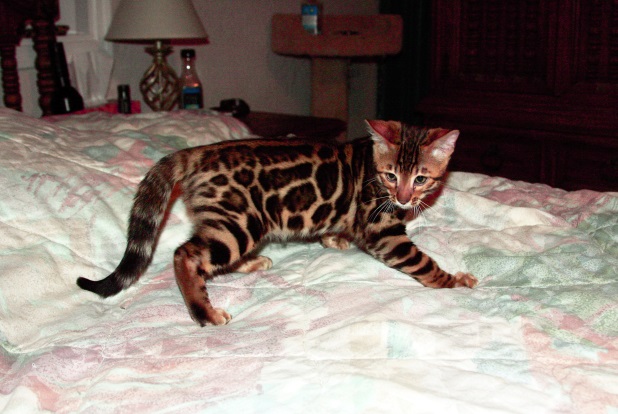 Once in a while things come together in an
unforeseeable way that gives pride to a breeder's efforts in raising Bengal
cats. Such is the case with our newest
young boy named Purrrcy. What follows is
Purrrcy's story of birth, mother's rejection, feeding, pottying, infections and
many other issues to resolve before our exquisite Purrrcy emerged strong and
healthy.
Once in a while things come together in an
unforeseeable way that gives pride to a breeder's efforts in raising Bengal
cats. Such is the case with our newest
young boy named Purrrcy. What follows is
Purrrcy's story of birth, mother's rejection, feeding, pottying, infections and
many other issues to resolve before our exquisite Purrrcy emerged strong and
healthy.
Breeding Bengal cats (or any animals)
requires the best combination of science and experience one can
accumulate. The care, happiness and
condition of any animal part of a breeding program requires the needs of that
animal come first. The needs of the
human are secondary to those of our Bengal cats.
It all began one evening in March. Purrrcy's mother, Bindi, seemed to be having
problems. We knew she was pregnant and
had carried her babies throughout her pregnancy with no problems, until about a
week before she was due to deliver. On
March 28 we began to notice a small amount of blood which made us very
concerned. Behavior-wise, she was
fine. But blood is never a good sign. Then, on Saturday night we noticed there was
pus with the blood. So, early Sunday
morning, we took her in for evaluation and possible caesarian section
(C-section). Fortunately, the vet was
not overly booked, so he could fit us in.
While the bleeding was concerning, the pus
indicated an infection and made the C-section necessary. So, as worried as we were, we left Bindi in
our vet's hands and waited in the office for the result. Several hours and multiple cups of coffee
later, the results are known: Bindi had
three babies. Two were males and the
third was a deteriorating fetus that would have prevented Bindi from going into
labor! So getting her to the vet was
critical.
Now, we are faced with feeding the two preemies. But more concerning was would Bindi accept
the kittens? When kittens are taken by
C-section, there is always the chance the mother won't recognize them as she
did not participate in birthing them. A
lot goes on when a Bengal kitten is born naturally as the mother smells and
licks the newborn as it is being pushed out. This part, Bindi missed. So, how
she will react to the two Bengal kittens is unknown.
The vet staff believed she would do well
as they put her Bengal kittens next to her. But, she was still under the anesthesia and had no idea what was going
on. The vet actually wanted to euthanize
the weaker kitten before we took them home, but we said no, we wanted to give
him a chance. He gave the other a 10%
chance of survival.
We decided to stay in the hospital a while
and have the staff help us figure out how to bottle feed the two young ones. One of the technicians had good success
bottle feeding both Bengal kittens. But
when we tried, it was not easy and we were worried we might lose them. So, we worked hard to learn how to bottle
feed and took Bindi and the kittens home.
Both kittens were struggling to recover
from being exposed to the infection due to the aspiring fetus. One was extremely weak and barely moving and
despite all our efforts, that kitten passed away that Sunday evening. So, at this point, we had only one kitten
left and Bindi was not ready to accept him and, in fact wanted to kill them.
So, now we had to figure out how to feed a
premature Bengal kitten and, of equal importance, how to potty him as
necessary. We had already bought cans of
KMR. KMR is a liquid milk replacement
for the mother's milk. During this time,
we also had to keep in mind that Bindi's milk glands need to be developed and
the kittens need the colostrum from Bindi to develop good immune systems. But, Bindi doesn't know he belongs to her. So, we went ahead and held Bindi so the
kitten could nurse. We did not know if
it would happen, but we needed to try and if unsuccessful, we would try again. Losing the one kitten was devastating, but we
must persevere.
We did get the one kitten to nurse a
little, but not enough to sustain him. Bindi did not know her kitten and could not be trusted alone with
him. In fact, she showed no sign of
wanting to mother him. She treated him
as a "thing". This was not good. We had to put him with her periodically and
stay with them to make sure she would not hurt her kitten while putting him on
her nipple and making sure he was able to suck without getting bit or pushed
off.
Without the continuous care a mother cat
can provide, we had to improvise. That
means several things. First, we had to
keep him in a bathroom in a box with a heating pad covered with towels to keep
him warm, but not too warm. Some people
have a knack to bottle feed, but we were unable to get the kitten to nurse from
the bottle. The alternative is to tube
feed. This has to be done very carefully
and with the right equipment. We have
had bad luck doing this in the past, but learned we may have lost kittens due
to the tube being too thin and turning around as we inserted it making the milk
go into the lungs. Our vet schooled us
to use a larger diameter tube (#10 for his age) that will not turn upon itself
during insertion. What a difference it
did make. Next, we had to follow a
careful schedule of feeding volume so as not to exceed the capability of his
digestive system. For a premature (preemie)
we had to start with 0.5 mL every two hours.
Oh, and before I forget, because of the
infection caused by the deteriorating fetus, we had to give injections of
Clavamox inra-muscularly twice a day for five days! Try that on a preemie weighing less than 97
grams. Again, these are the kinds of
issues that can occur in a breeding program and the humans involved must have
the capability to do all that needs to be done.
Now, this feeding schedule is
critical. And, one might notice that
feeding with such frequency does not allow sleeping. Further, even though there are two of us, it
took both of us to prepare the KMR, insert the tube and deliver the small
amount of KMR and make sure it goes into his stomach and does not come up on
him. There are those who do these things
alone, and so have we, but a premature kitten takes a little more caution to be
sure everything is done right, so for the first day, we fed every hour, and as
the week progressed, we were able to go to two hours between feedings.
Then there is the matter of making sure he
goes potty - both 1 and 2. The procedure
is variable depending on the need. For
example, if after a feeding, he does not go, he would be pottied before the
next feeding and checked after feeding. The basic procedure we used was to take a tissue and, with a little warm
water applied to the tissue, begin gently massaging his excreting areas. Usually, he will give urine right away. He may not defecate every time, but, here is
where one's gut instinct comes in. Should he be defecating by now? So, we might try a little longer. This went well until the eighth day of feeding at 4:00 a.m. He needed a little help. He was not defecating. We began to suspect he was constipated. But, how do you get a one week premature
kitten to be un-constipated? Not knowing
any better, we have used baby fleet enema successfully in the past on very
young kittens, but not on premies. It
was the zero dark thirty timeframe and could not call anyone. So, with the enema in hand, we noticed the
extreme difference between the enema container diameter and Purrrcy's
rectum. But, we had one of those thin
feeding tubes the vet said not to use for feeding, but it was just right for
this application. To be safe, we used
only up to about 0.1 cc of the enema drawing it up through the tube so we did not have to account for the
fluid that stays in the tube.
At first, it was like hitting a brick wall with the tube trying to insert it. That confirmed he was constipated. So, we had to push a little of the enema fluid outside this rectum to sort of lubricate the area so the tube could be inserted past the hardened poop. We had to maneuver the tube around and in and out until it got past the hard portion. Then we inserted the enema and like a broken dam, the poop came shooting out - tons of it. It must have been six inches long or more. Now, we reviewed this with our vet and he said the baby fleet enema can cause death in very young kittens if too much is used. But, a review of the ingredients used today in Fleet's Pedia-Lax, shows the product has been changed by removing any sodium or phosphorous ingredients and, instead, they use Glycerin as the only active ingredient. Our vet may have been recalling the older formula that contained sodium and/or phosphorous. Since this new formula is what we used, we felt safe as glycerin is a safe, non-toxic substance - even to very young kittens. We advise everyone, however, to read the ingredients on any enema to be sure it does not contain harmful ingredients. While our vet prefers using warm water, the new Pedia-Lax is also a safe approach. So, while his solution may have been safer in the case of using the older formula, our procedure worked very well using the Pedia-Lax with Glycerin as the active ingredient and more time could not have been spent waiting as his system needed to be un-clogged right away.
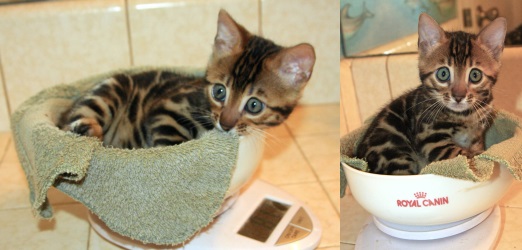
One must have a good scale to keep tract of
whether or not he is gaining weight. We
have an excellent electronic scale with a bowl that he fits comfortably within
and we can select grams, kilograms, ounces or pounds as one needs. For Purrrcy, we used grams at this stage. It was not possible to gain weight on him for
the first week. The vet said, for preemies,
we are lucky to keep the weight constant and not lose. And along about day eight of feeding, we
began to see some weight gain.
Also during this first week, we had to
inject fluids under the skin to keep him from dehydrating. All these things were carefully noted every
feeding, every fluid injection, every enema, every excretion and his weight was
recorded after every feeding. There were
scares along the way that we had to think through like milk coming out his
nose. One suggestion was if milk does
get in the lungs, hold the kitten upside down (tail up and head down) and the
fluid will drain and it did! Whew!
So, we found ourselves going to the
internet constantly whenever we needed to solve problems or find answers. Then on about the 11th day, we
noticed his eyes were still closed, but one was bulging. We have seen this before. In fact, on a Bengal kitten we saw the same
bulging and the eyes were not opening. Then, one opened and the eye popped out! So, we took the kitten to a vet
who said that could not happen and in his office, the other came out in his
hand. So, we know what it means when the
eye should be open, but is swelling under the eye lid: infection.
We took him right to our vet who was very
impressed we knew what was going on as he had seen multiple cases where the people
did not have a clue and lost the eyes. He took Purrrcy in the back to open his eye lids and to apply
antibiotic. Good news was his eyes were
in good shape and we got him there in plenty of time to treat him.
Now, all during these first 11 days, we
put him with Bindi to both keep her milk glands working and to help her develop
a bond with him. This did not seem
possible in the first week, but gradually, she began to accept him including
cleaning him. This was needed and much welcomed
as we were getting worn out with lack of sleep. But this shows that breeders must persist to make sure all the right
things are being done and the cats are receiving the best of care. We knew that time was on our side -
eventually.
So, let's review. Bindi had one deteriorating kitten that was
threatening the health and well-being of the other two. A C-section one week before her schedule due
date (day 63 from mating) was the only way to save the kittens. We lost one in spite of our best efforts due
to the infection. Purrrcy was on his own
and given only a 10% chance of survival. During his first 11 days, we had to tube feed him, inject him with
antibiotics twice a day, inject fluids as needed for dehydration, potty him
before/after each feeding and treat his eyes for infection as many times a day
as possible.
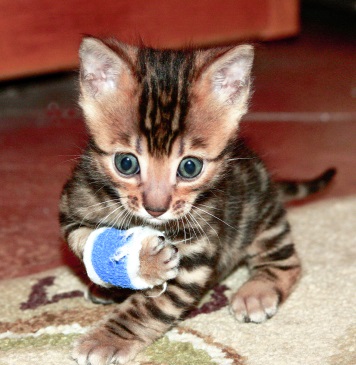 His weight never stayed above 100 grams
until this time. It was difficult giving
him more than 1.5 cc per feeding until day eight. Now we upped it to 3 cc per feeding and by day
14 he was up to 5 cc per feeding. This
seems right to me because the entire first week he would have been inside his
mother, so that explains why he did not grow during that week. If he was in his mother, nature would not
want him to grow so big he could not be delivered naturally. So, we just discount the first 7 days and all
seems to fall into place.
His weight never stayed above 100 grams
until this time. It was difficult giving
him more than 1.5 cc per feeding until day eight. Now we upped it to 3 cc per feeding and by day
14 he was up to 5 cc per feeding. This
seems right to me because the entire first week he would have been inside his
mother, so that explains why he did not grow during that week. If he was in his mother, nature would not
want him to grow so big he could not be delivered naturally. So, we just discount the first 7 days and all
seems to fall into place.
By 6:00 p.m. on day 21, Purrrcy was
accepted fully by his mother who fed and cleaned him constantly! Now we can sleep through the night. After all the weighing's we did in the bowl
on the scale, Purrrcy purrs every time we take him in the bathroom to be
weighed. He never forgot his everyday
routine and really likes sitting in the bowl - although he is getting too big
to fit in the bowl.
Problems solved, right? Wrong. Now we notice his right front foot collapses when he tries to walk; back
to the vet on 28 April. The vet pointed
out that the leg needs to remain straight during early development or it won't
grow right. He came up with a soft
splint using a thin cotton fabric wrapped first and held in place with vet
wrap, but not too tight. So, that seemed
nifty, so we took him home and found the wrap slipped off. We came up with a solution using double
sticky tape, but the next morning, while the wrap was still on, his foot was
swollen. So, we removed it and let the
swelling go down and then re-wrapped looser and all worked well. And, after a week or two, it was amazing how
what appeared to be a lack of bone became a normal leg and he was able to
support himself very well.
Well, we still are not out of the
woods. We found Purrrcy vomiting for
some reason. We took him in as this was
a show stopper. The vet prescribed
medicine to prevent vomiting. After
treating him for some time, we caught him eating the clay cat litter! Wow. So, anyone would vomit after eating clay cat litter. So, stop the med and find a litter
solution. We started using an old
standby: wood pellets. But, then he
would not use the litter. There was poop
everywhere but in the litter box. After
some research, we found Yesterday's News. Now, this is also like the wood pellet, but it is much smaller and comes
in two types: hard and soft. He liked
the small soft after we put it in a litter box with lower sides making it easy
for him to get in. So, we are still
using Yesterday's News and he is using his litter box religiously.
So, that is Purrrcy's story; a story of
how a premature Bengal kitten, rejected by his own mother can be given the help
he needs until his mother gets over the anesthesia and lack of natural
birth. But through it all, there is one
attribute that shines above all others and that is Purrrcy's perseverance to
overcome all the issues he faced. With
that in mind, we named him Summermist Purrrseverence as his registered name
giving "Purrrcy" as his call name.
Since our
initiation into Bengal Cats in 2001, Summermist Bengal Cats has come a long way in producing beautiful Rosetted Bengal cats. So, as we approach another year breeding and showing Bengal Cats and Bengal kittens, we feel it
is time to look back on how we did and where we are going.
First, our
philosophy in breeding always places our animals first in everything we do.
No show is so important that we risk the health of our Bengal cats or anyone else's
to attend. At home, our Bengal cats always come first for food, cleaning, health,
love and attention. We work closely with Southern California's finest
veterinarians to provide our Bengal cats with the finest in health care. All of
our Bengal kittens for sale are checked by our local veterinarian to assure every Bengal kitten has the
healthiest of starts with their new owners.
From 2001
to 2005, we learned about raising Bengal Cats, how the show process works and
met many new friends and acquaintances. Along the way we completed the
following significant accomplishments:
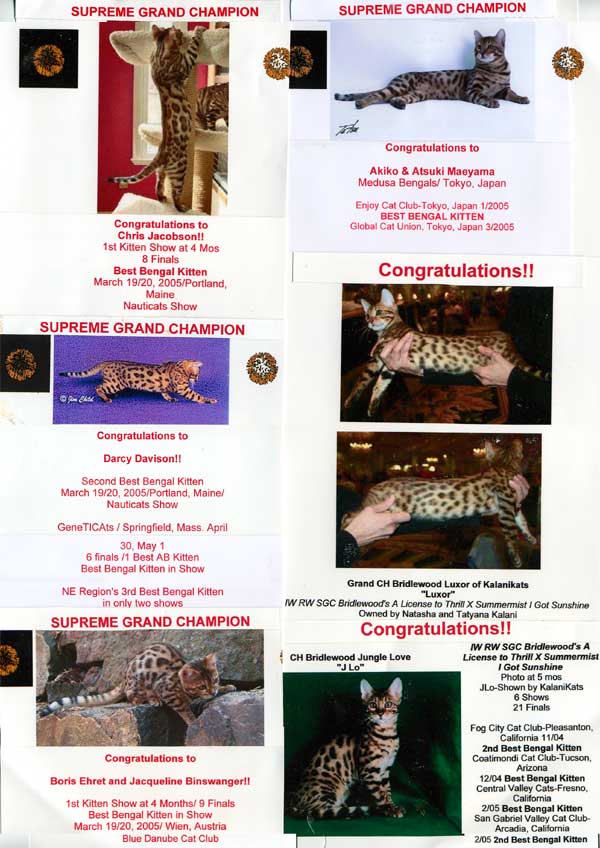
• Eligible
for the TICA Top Producing Dam Award for Summermist Sunshine who produced 7
Supreme Grand Champions in a single year.
• Achievement
of Double Grand Champion (DGC) for Belara Ducati of Summermist, "Ducati"
in the 2004 show season.
• Achievement
of the top Bengal in the Great Lakes Region for RW SGC Wildlove Quatro Diablo ("Pizza").
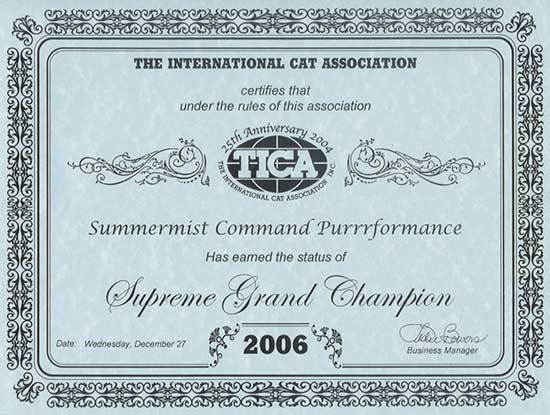
• Achievement
of Supreme Grand Champion for SGC Summermist Command Purrrformance ("Perry").





 Please Read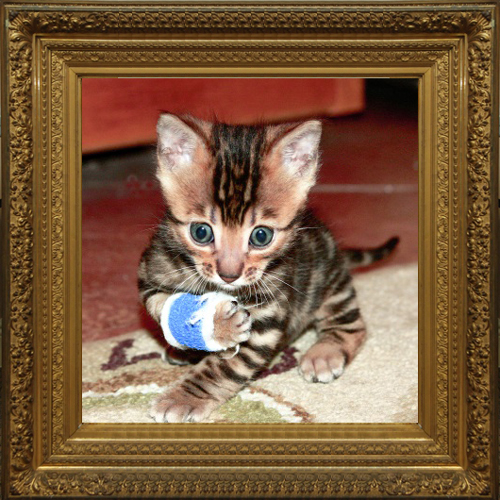
 Click To Close